Education & Career Success Guide: Bacteria
Showing posts with label Bacteria. Show all posts

What are bacteria?

00:21
What are bacteria?
Bacteria are living things that are neither plants nor animals, but belong to a group all by themselves. They are very small--individually not more than one single cell--however there are normally millions of them together, for they can multiply really fast.

  •     See bacteria multiply in just a few hours in a 520 k time lapse movie.
  •     A simple and clear description about Bacteria is given..
  •     Here's what the specialist says: Enter "Microbe World". Have fun browsing through that one!
  •     OK, one more: a Description of bacteria.
A brief synopsis of the diverse world of bacteria, where you can learn that not all bacteria are harmful, is found in the Nature Bulletin. Another very informative site to visit is the Bacteria exhibit of the Museum of Paleontology, where you can also find a drawing and explanation of the inside of a typical bacteria. More details on bacterial structures are further explained in The New Microbial World, an introductory textbook for students of which the first 3 chapters are online.
    If you're curious what bacteria look like, check out our Special Feature Exhibit: Images of bacteria.

A number of bacteria cause disease, these are called pathogenic bacteria. They are the subject of Medical Microbiology and the exhibit pathogens deals with them. A separate exhibit explains about bacteria and food safety. Fortunately our immunesystem knows how to deal with them. However not all bacteria are 'bad guys'. We need bacteria to stay alive, as is explained in our exhibit commensals.

Bacteria are prokaryotes (single cells that do not contain a nucleus). It may seem weird to classify organisms according to such details, but having or not having a nucleus is not trivial at all. The division between prokaryotes and eukaryotes (all organisms with a nucleus inside their cells) is of extreme importance in biology, and is the result of a major evolutionary breakthrough. Visit our other exhibits if you want to know more about bacteria and evolution, or in what extreme environments bacteria can be found.

Microbiology is the study of prokaryotes, eukaryotes (as long as the organism is microscopically small) and viruses. What is the difference between bacteria and viruses?. Did you know that bacteria can be ill too? In our museum Bacteria are in the center of the picture, but there also are many other micro-organisms that can be useful to mankind or cause infectious diseases. 

Bacteriology is the study of bacteria.. Bacteria can be used for 1001 applications. That bacteria occpy a niche in teh ecosystem where they live is explained in our Special Feature Exhibit on microbial ecology.
Read More

Types of infections, Effects & Symptoms

22:43
Types of infections, Effects & Symptoms
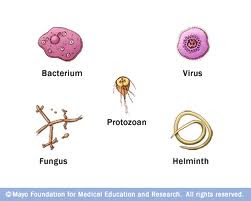
This page tells you about different types of infections and cancer. There is information on


    Infections and our immune system
    Bacteria
    Viruses
    Fungal infections
    Protozoal infections

 Infections and our immune system

Infections are caused by tiny living things (organisms) that get into your body and start multiplying. Some organisms are harmless and help our bodies to work properly. But others cause disease. If these organisms get into your body, and your immune system can't fight them off immediately, you may get an infection that makes you ill. If you do not treat the infection, it may end up causing serious health problems. Some infections are life threatening, particularly if you have low resistance to infection from cancer treatment.

Some types of cancers and cancer treatment can weaken your immune system. They stop your bone marrow from making blood cells that help fight infection. This increases your risk of getting an infection.

The white blood cells play the biggest part in fighting infection. Doctors call a low white blood cell count neutropenia (pronounced new-tro-peen-ee-a).

We’re all normally covered with bacteria that don’t do us any harm. But people with neutropenia are at risk. They can get infections from bacteria or viruses that normally live on their skin or inside their digestive system.

Some of the scientific names of these organisms are very long and complicated. We have described some here in case your doctor talks about them.

Bacteria

Bacteria are the most common cause of infections in people with cancer. Types of bacteria that cause infection include

    Staphylococcus
    Streptococcus
    Pseudomonas
    Clostridium difficile
    Escherichia coli
    Listeria monocytogenes

Staphylococcal infections (often shortened to Staph) mainly affect the skin. Two common types are Staphylococcus epidermis and Staphylococcus aureus. They usually cause mild infections, but these can be more serious in people with cancer. MRSA is a type of Staph aureus infection that standard antibiotics can’t treat. MRSA stands for Methicillin Resistant Staphylococcus Aureus. There is more information about MRSA in our questions about cancer treatment section.

Streptococci (often shortened to Strep) are common bacteria that can cause tonsillitis and skin infection (cellulitis). They are usually treated with antibiotics like penicillin. Pneumococcal pneumonia is a chest infection caused by a type of strep, especially in people who have had their spleen removed.

Another type of bacteria that can affect people with cancer are Enterococci. These can cause bladder infections and blood poisoning (septicaemia).

Pseudomonas infections are more rare, but can be a problem for people who have weak immune systems or who are in hospital for some time. The germs live in soil, water and on the skin.

Clostridium difficile infection is most common in people who are already on antibiotics. Certain bacteria can live normally in the bowel in just the right numbers to keep it healthy. But being on antibiotics can upset the balance and allow some bacteria to multiply and become harmful. This is what causes Clostridium difficile or C. diff, as it is often called. Symptoms include diarrhoea, abdominal pain and fever.

Escherichia coli (E. coli) infections also affect the gut causing diarrhoea and fever.

Listeria monocytogenes is commonly known as Listeria. The infection is caused by eating contaminated food. It is rare, but can be serious if caught by pregnant women, unborn or newborn babies, elderly people, or those with a weak immune system. A recent study showed that people with cancer may have an increased risk of developing the illness. You can reduce your risk of listeria infection by avoiding certain foods, including

    Pre packed and sliced delicatessen meats
    Soft cheeses
    Smoked fish
    Paté
    Pre prepared cooked chilled meals
    Pre prepared sandwiches
    Un pasteurised milk

There are tips for when you have low blood counts in our section about your blood, bone marrow and cancer drugs.

Viruses

Viruses are tiny particles that can't live on their own. To reproduce, they need to infect a living cell, such as a cell in a human body.

It is a virus that causes flu. The most common types of viruses that cause infections in people with cancer include

    Common cold viruses
    Herpes simplex
    Varicella zoster
    Cytomegalovirus (CMV)
    Flu (influenza)

Common cold viruses occur often in healthy people and do not usually cause major problems. But these viruses can cause serious infections, such as pneumonia, in people whose immune systems are weak. If you are having cancer treatment that weakens your immune system, you should try to stay away from people with colds. This may seem impossible if you are having treatment during winter in the UK, when everyone you meet seems to have a cold! You can only do your best with this one.

Herpes simplex is a virus that causes cold sores and genital herpes. In people with healthy immune systems, these infections are usually mild. But the virus can cause serious infections in those with weakened immune systems, including some people with cancer.

Varicella zoster is related to the herpes simplex virus. Varicella zoster is the same virus that causes chicken pox. It can cause very serious and sometimes fatal infections, such as pneumonia, in people with cancer. The virus also causes a painful condition called shingles. You can only get shingles if you have had chicken pox in the past. This is because after you've had chicken pox the virus does not fully go away. It lies inactive in the body, but can become active again if the immune system is weak. This is why people can get shingles after chemotherapy treatment.

Cytomegalovirus (CMV) is common and can cause several types of infections. Cytomegalo just means large cell, which is how the infected cells look under a microscope (swollen and big). Most people will have had a CMV infection by the time they are adults. It isn’t generally serious. But the virus can remain inactive in your body for many years and cause recurrent infections. This usually only becomes a problem in people who have very weakened immune systems. For example, it can cause serious chest infections after a stem cell or bone marrow transplant.

Flu is an infection caused by viruses. It is very infectious. You mainly catch it from coughs and sneezes of people who have a flu virus. When you have flu you feel unwell more quickly than with a cold. Flu often causes

    High temperatures (fever)
    Aching muscles
    Coughing
    Headaches

Many cancer treatments can affect the immune system, so you are less able to fight infections. It will take you longer to recover from flu if you do get it. And you are more likely to develop complications such as chest infections. Your doctor may suggest you have the flu jab and will tell you how and when to get it. There is more information about the flu vaccine in our question and answer section.

Fungal infections

Fungi can live in our bodies without causing any problems. But if a fungal infection occurs when your immune system is weak, it can cause problems. The most common fungal infection in people with cancer is Candida, often called thrush. If you have a sore mouth from chemotherapy or radiotherapy treatment you are more at risk from thrush. Chlorhexidine mouthwashes can help to prevent thrush in the mouth. You may notice white patches with red and sore skin underneath. Thrush can be treated with an anti fungal drug called nystatin. This is given in liquid form which coats the inside of the mouth and throat. Or a gel such as miconazole may be applied to the affected areas. If the infection does not respond to either if these treatments, doctors may uses a drug such as fluconozole. Women can also get vaginal thrush, which is treated with anti fungal creams or pessaries.

Less common fungal infections are aspergillosis and pneumocystis. These infections may be a serious problem for people who have very weak immune systems, for example after a stem cell or bone marrow transplant. Aspergillus can cause a serious chest infection that needs treatment with anti-fungal drugs through a drip. And the pneumocystis bug can cause a serious form of pneumonia called PCP. This stands for pneumocystis carinii pneumonia. Doctors use the drug co-trimoxazole (Septrin) to help prevent or treat it.


Protozoal infections

Protozoa are the smallest animals known to man. Toxoplasmosis is an infection caused by protozoa. It causes a mild illness in healthy people, but those with severely weakened immune systems can get serious infections that spread to the brain.

Remember many of these infections are only a problem if your resistance to infection is very low. If you are worried about your risk of getting infections do talk with your doctor or specialist nurse.
Read More